
C A L A I M
““That is your perception of the situation, grant funding, and housing laws to the best of your ability.”
”
I thought so too. Then I started reading the contracts. Then the waivers. Then the webinars. Then the regulations.
Then the funding structures. Then the program requirements.Eventually I stopped asking whether I understood the system.I started asking whether the system understood itself
California Advancing and Innovating Medi-Cal (CalAIM) aims to transform Medi-Cal into a coordinated, equitable, and person-centered health system that addresses both medical and social needs
Core Goals
Integrate care: Combine physical health, behavioral health, dental care, and social support services.
Reduce disparities: Advance health equity and improve overall care quality across the state.
Address social drivers: Tackle root causes of poor health like homelessness, food insecurity, and environmental triggers.
Key Initiatives
Enhanced Care Management (ECM): Provides high-need members with a single lead care manager to coordinate in-person care within the community.
Community Supports: Offers up to 14 pre-approved services addressing health-related social needs, such as housing navigation, medically tailored meals, and asthma remediation.
Behavioral Health Integration: Streamlines mental health and substance use services with physical healthcare systems.
Population Health Management (PHM): Establishes a statewide framework for managed care plans to proactively manage and improve member health outcomes.
2022: High-Risk Adults ──> 2023: Youth & Justice ──> 2024: Full Scope Inclusivity ──> 2025-2027: Dual Eligibles & System Refinement
The Roll Out Timeline.
1. 2022: The High-Risk Adult Baseline
When CalAIM launched, it intentionally targeted vulnerable adults with high medical costs or severe social determinants of health to reduce avoidable emergency room and nursing home placements:
Individuals Experiencing Homelessness: Adults needing complex medical care alongside housing navigation.
High Utilizers: Individuals with frequent, avoidable emergency room visits or hospitalizations.
Serious Mental Illness (SMI) / Substance Use Disorders (SUD): Adults requiring integrated physical and behavioral health care.
Institutionalization Risk & Nursing Home Transitions: Seniors and individuals with disabilities trying to avoid nursing homes or transition back to the community.
2. 2023: Focus Expansion to Youth & Justice
In 2023, CalAIM shifted from purely adult-centric populations to include families, youth, and historically marginalized institutional systems:
Justice-Involved Re-entry: Individuals transitioning out of state prisons, county jails, and youth correctional facilities who require immediate physical and mental health continuation.
Children & Youth: Children with complex medical needs (such as California Children’s Services eligibles) and youth with intensive mental health struggles.
Foster Care / Child Welfare: Current and former foster youth needing intensive care coordination.
Birth Equity: Pregnant and postpartum individuals facing systemic social inequities or high risk for poor birth outcomes.
3. 2024: The Immigration Status Expansion
A massive structural shift occurred. While not exclusively a CalAIM clinical initiative, California became the first state in the nation to open full-scope Medi-Cal to all income-eligible adults, regardless of immigration status.
The Shift: This meant that hundreds of thousands of undocumented Californians newly qualified for managed care, making them eligible to be screened for CalAIM’s complex Enhanced Care Management (ECM) and Community Supports if they met the health criteria.
4. 2025 to Present (2026/2027): Dual Eligibles & Continuous Scaling
The program is currently standardizing the care models for the state's most complex ongoing populations:
Dual Eligibles (Medi-Medicare): Integration of individuals who qualify for both Medi-Cal and Medicare, aligning their managed care plans to prevent fragmented treatment.
Long-Term Care Managed Care: Continued mandatory enrollment of remaining long-term care populations into managed care plans to ensure they receive proactive oversight.
Broad Population Health Management (PHM): Transitioning from managing just the "sickest" populations to using proactive data tracking to prevent all Medi-Cal members from becoming high-risk in the first place.
If you're researching a specific angle of this evolution, let me know:
Are you tracking the funding changes (like the transition of PATH grants) across these years?
Do you need details on a specific population's clinical triggers (e.g., what exactly qualifies someone as a "high utilizer")?
The Providing Access and Transforming Health (PATH) initiative is a five-year, $1.85 billion multi-pronged grant program designed to build infrastructure for community partners transitioning into CalAIM. Because local providers (like food banks or homeless shelters) historically lacked medical billing and healthcare IT frameworks, PATH funding operates as the bridge allowing them to participate in the Medi-Cal delivery network.
The allocation of PATH funding relies on distinct initiative tracks that map exactly to the target population evolution from 2022 to the current 2026 milestones:
Timeline & Funding Milestone Tracker
🔹 2022: Foundations & CITED Launch
Whole Person Care (WPC) Pilot Transitions (Jan 2022): Initial local mitigation funds were deployed to ensure counties previously running "Whole Person Care" pilots did not lose data continuity during the CalAIM transition.
CITED Round 1 & JI Round 1 (Summer 2022): Applications opened for early-adopter Community-Based Organizations (CBOs) and initial planning assessments for justice-involved settings.
🔹 2023: Justice and Collaboration Ramp-Up
Collaborative Planning & TA Go-Live (Jan–Feb 2023): Disbursal of regional planning dollars. The Technical Assistance marketplace launched to give smaller providers free administrative guidance.
Justice-Involved Rounds 2 & 3 (March–July 2023): Large implementation grants closed for correctional facilities to purchase the data systems required for pre-release enrollment.
🔹 2024: Massive Infrastructure Injections
Mid-Waiver Capital Surge (August 2024): The California Department of Health Care Services (DHCS) awarded $146.6 million to 133 organizations under CITED to rapidly expand local workforce capabilities as new population groups launched.
🔹 2025: Expanding the Network Size
Continuous CITED Awards (November 2025): An additional $145.5 million was awarded to 153 Enhanced Care Management (ECM) and Community Supports organizations to keep pace with growing member volume.
🔹 2026 (Current Status): Cumulative Milestones & Wind-Down
As the five-year PATH program moves through its final scheduled year (concluding December 31, 2026), the cumulative state totals showcase a widespread impact:
CITED Impact: Over $639 million has been successfully distributed across Rounds 1–4 to 575 entities, targeted heavily at expanding care availability in rural and historically underserved regions.
TA Marketplace: 945 recipients utilized free operational consulting across 1,681 distinct projects.
Collaborative Coalitions: 1,732 distinct organizations are now actively communicating across 26 regional hubs to resolve local care gaps.
What Happens Next?
The current PATH grant lifecycle is wrapping up at the end of 2026. However, the state has actively applied for a CalAIM 1915(b) waiver renewal spanning January 1, 2027 through December 31, 2031. The focus of future funding will transition from building infrastructure via PATH grants to sustaining long-term delivery using data metrics managed via the CalAIM GeoHub Data Portal.
How I Started Connecting The Dots
I didn't start this project because I wanted to become an expert in Medi-Cal, CalAIM, ECM, housing systems, HMIS, waivers, contracts, compliance, or any of the other things covered on this site.
I started learning this stuff because I was trying to survive. At first, every problem felt separate. Housing was housing. Behavioral health was behavioral health. Substance-use services were substance-use services. Disability accommodations were disability accommodations.Case management was case management.
The hearing was the hearing.The eviction was the eviction.The records were the records. That's how it felt from the participant side.Then I started realizing all of these systems were talking to each other behind the scenes.
The same names kept showing up.The same organizations kept showing up.The same contracts kept showing up. The same buzzwords kept showing up.
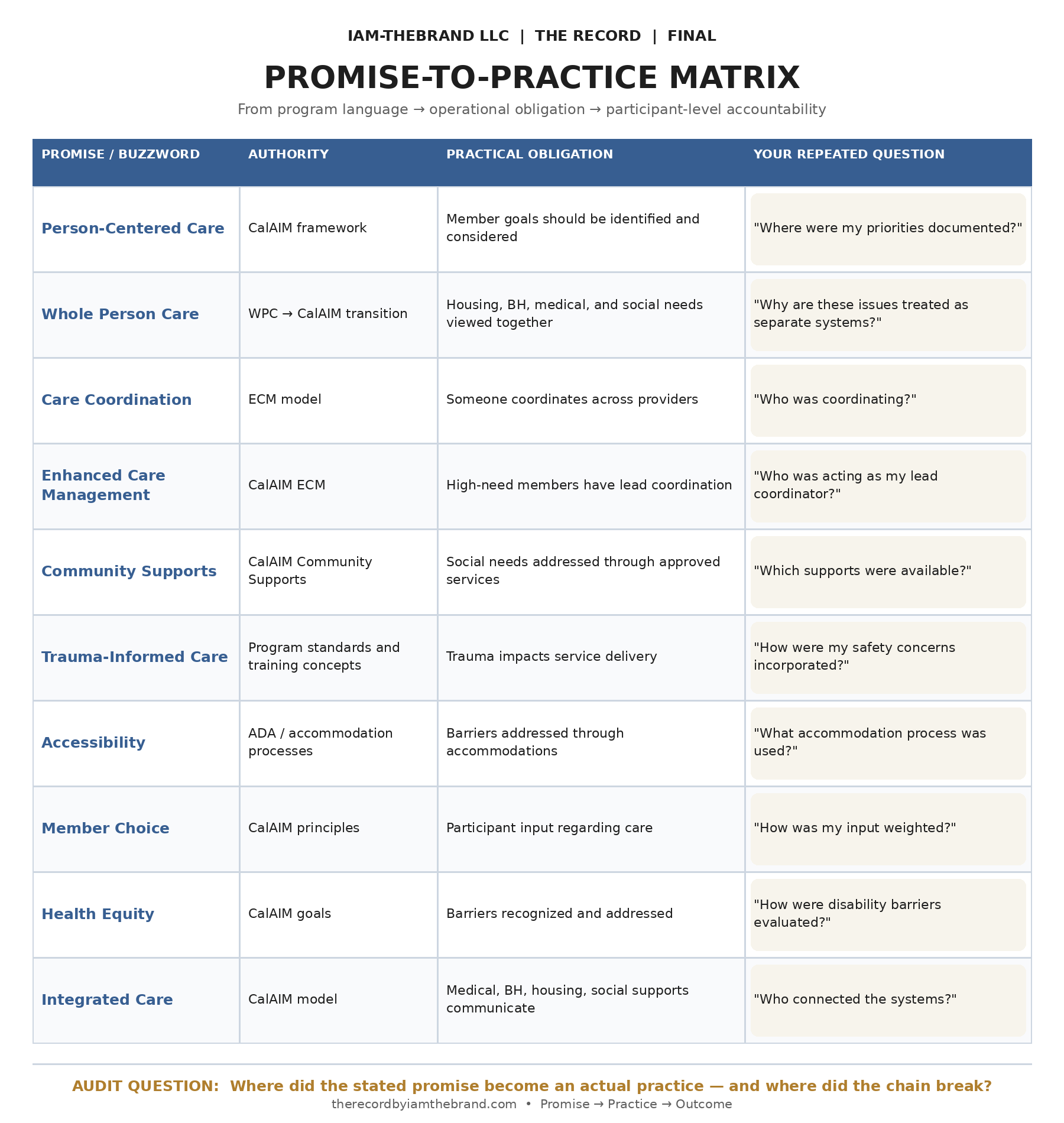
Person-Centered Care. Whole Person Care. Community Supports.
Enhanced Care Management. Health Equity. Trauma-Informed Care.Care Coordination.
I kept hearing the same language over and over again.At first I thought it was just program jargon.Then one day something clicked.I realized they weren't talking about separate systems anymore.They were trying to connect all of them.
Housing.Behavioral health.Managed care. ECM. Transportation.Food insecurity.Disability.Community supports. Recovery.
Everything.Once I realized that, I stopped looking at my life as individual events and started putting things on a timeline. When was I in residential treatment? When did Whole Person Care end? When did CalAIM start?When did ECM roll out?When did my housing situation change?When did I leave Specialty Mental Health?When did the funding structures change?When did the waivers change?When did everybody suddenly start using different language?I wasn't looking for a conspiracy.
I was looking for context.
Because from where I was sitting, it felt like my entire life was being affected by systems that were changing while I was inside them. The more webinars I watched, the more contracts I read, and the more records I reviewed, the more I started noticing the same thing:
The participant experience and the program timeline kept overlapping.
Not proving anything.
Just overlapping.
And that became interesting.
Because I kept hearing promises.
Housing stabilization.
Care coordination.
Member choice.
Person-centered care.
Whole-person care.
Community supports.
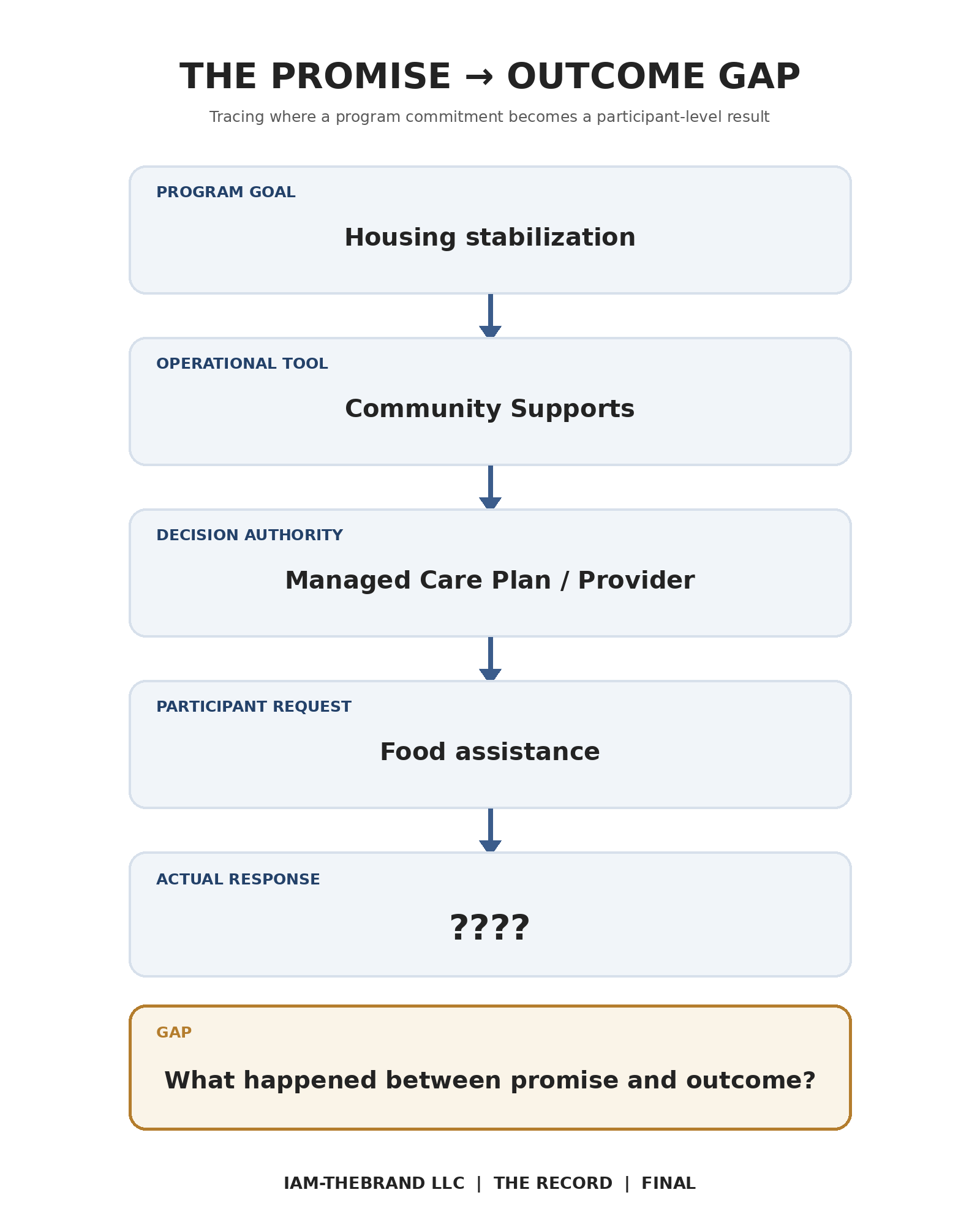
Then I compared those promises with the questions I kept asking. Who is coordinating?Who do I call?What support is available?How are my barriers being evaluated?What accommodation process is being used?What happened to my request?What about my situation isn't being taken seriously?That's when I realized the real story wasn't whether I won or lost any individual dispute.The real story was the gap between what the systems said they were designed to do and what participants actually experienced while trying to use them.That's what this project became.Not a grievance.Not a lawsuit.Not an attack.An audit.An attempt to follow the chain from:
Promise → Authority → Practice → Participant Experience → Outcome
and figure out where things connected, where they broke, and where people like me ended up falling through the cracks.Most people never have to learn any of this.I learned it because I had to.And once I started seeing the connections, I couldn't unsee them.