

Reconstructed cross-system table
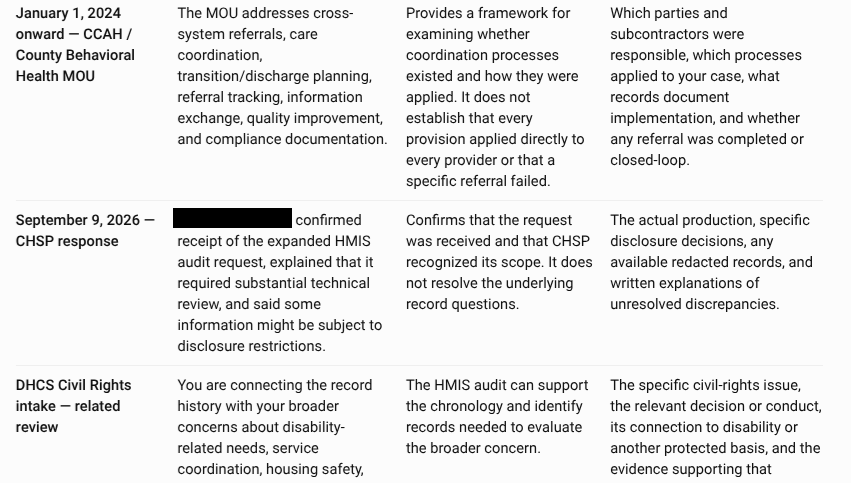
This version brings the HMIS audit request, CHSP’s response, the CCAH–Monterey County Behavioral Health MOU, and your housing and transfer history into one framework.
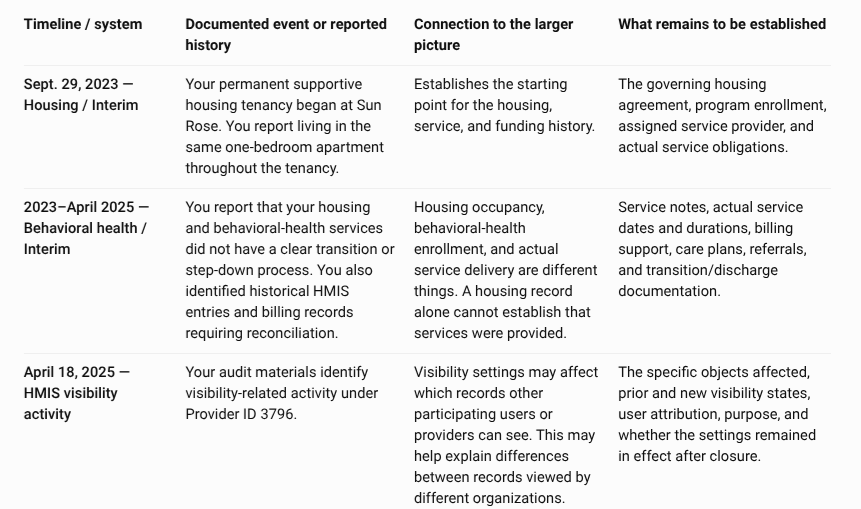
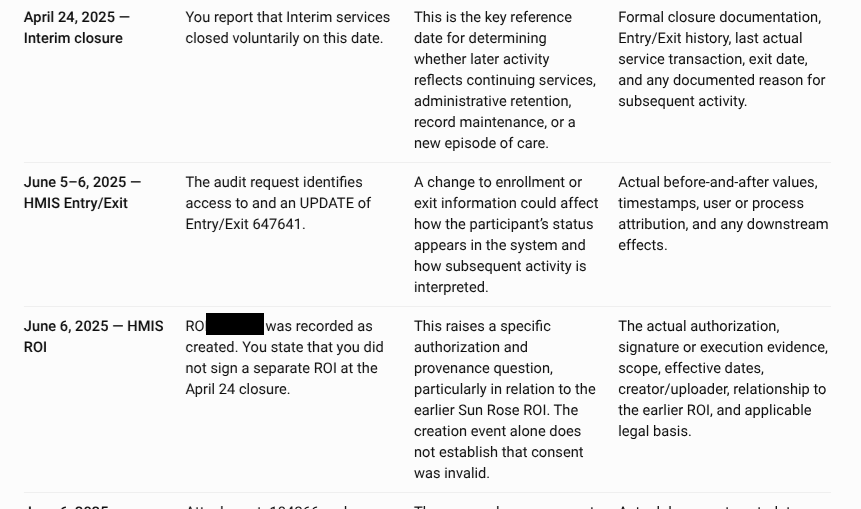
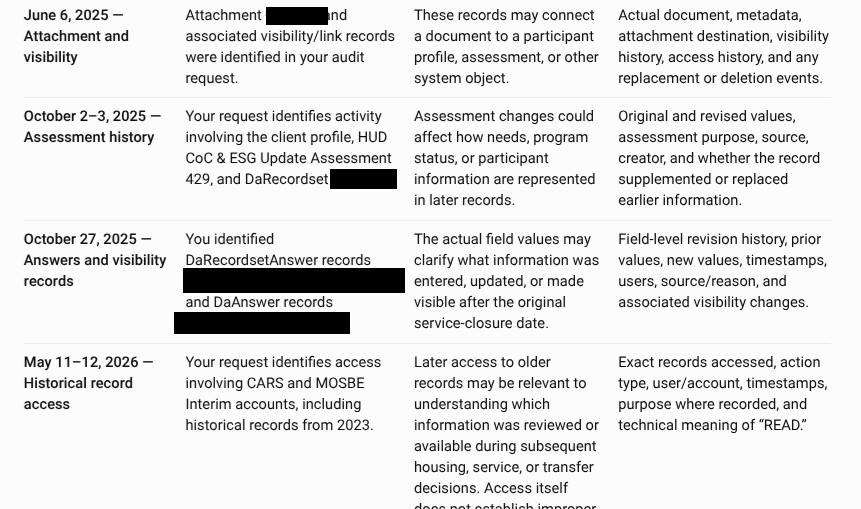
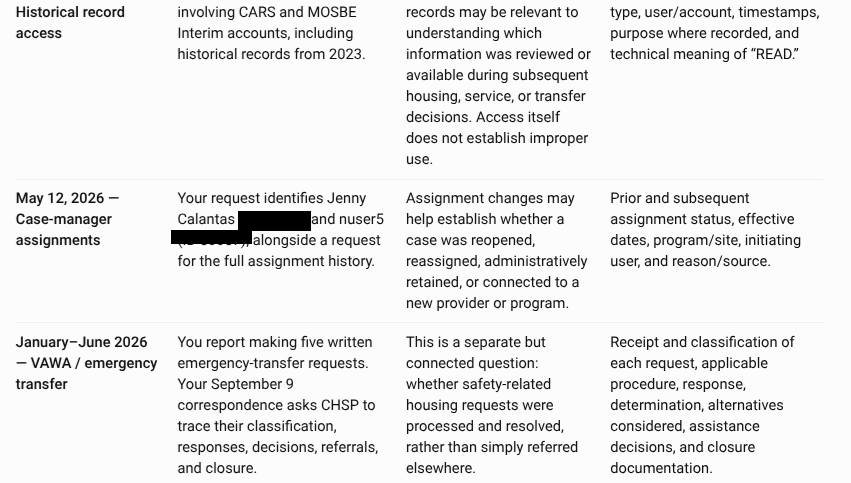
Cross-System Fragmentation and Its Impact
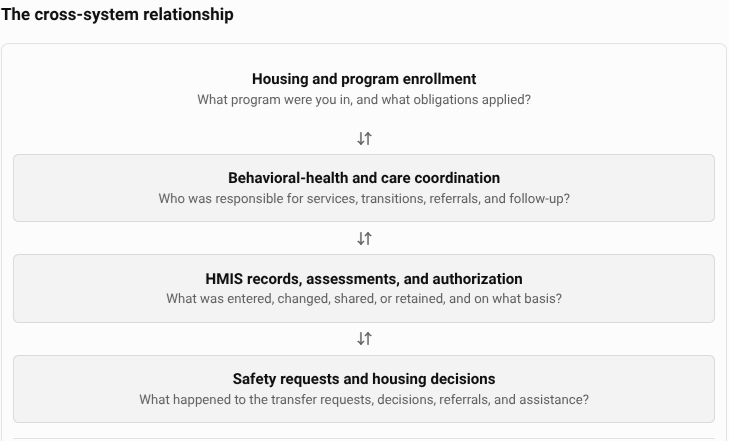
My concerns cannot be understood by reviewing each agency interaction in isolation. My housing placement, behavioral-health services, HMIS enrollment and assessment records, release-of-information history, care coordination, and emergency-transfer requests are interconnected. I have been attempting to reconcile these records because the explanations and documentation available to me have not established how the different systems connected, which organization was responsible for each step, or how outstanding matters were resolved.
I requested an expanded HMIS audit to identify the actual records, changes, authorizations, and responsible user accounts. I also identified the relevant provisions of the managed-care and County Behavioral Health MOU concerning referral tracking, care coordination, transitions, information exchange, and compliance documentation. I am not asking DHCS to assume that a discrepancy proves wrongdoing. I am asking that the underlying facts and applicable responsibilities be examined together.
The fragmentation has imposed a substantial administrative burden on me. I have had to reconstruct timelines, locate records, research program requirements, identify responsible parties, and repeatedly explain the same connected history while also trying to maintain housing, safety, and continuity of care. This is not a substitute for effective service coordination. I want the review to consider not only what each organization did individually, but also whether the processes intended to connect those organizations functioned in my circumstances, and how any failures or barriers affected my access to services, housing stability, and ability to pursue work and independence.
Disability-Related Access, Continuity of Care, and Systemic Fragmentation
My concern is not limited to isolated administrative errors or a lack of communication between providers. It concerns the cumulative effect of fragmented services, unresolved care-coordination questions, inaccessible or unexplained records, and the burden placed on me as a person with a disability.
My disability affects my ability to process complex information and navigate multiple administrative systems, particularly when information is inconsistent, records are unexplained, and responsibility is divided among organizations. Rather than receiving clear explanations, coordinated assistance, and an understandable process for addressing unresolved issues, I have had to reconstruct my own service history, obtain and interpret technical HMIS records, research program requirements, identify responsible entities, and repeatedly explain the same interconnected circumstances.
I am asking Civil Rights to examine whether disability-related barriers were recognized and appropriately addressed; whether reasonable accommodations and accessible communication were provided where required; whether the care, coordination, and other services applicable to my circumstances were delivered; and whether the cumulative effect of the agencies' practices impaired my ability to access services, exercise my rights, maintain safety and housing stability, and pursue independence.
I am not asking the Department to presume that every discrepancy proves a violation. I am asking that the records, applicable program requirements, accommodation history, and actions of the responsible entities be considered together rather than treating each incident as unrelated. The central question is whether the systems intended to support me functioned accessibly and effectively for a person with my disability-related needs.
Consistency of Program Requirements, Accountability, and Disability-Related Impact
My concern is that the organizations involved had established program requirements, interagency agreements, care-coordination procedures, and oversight responsibilities, yet the circumstances of my case have not been reconciled against those requirements in a clear and accountable way.
I have repeatedly engaged with agency personnel, including senior management, attended meetings, visited public-benefit offices, and attempted to obtain and disclose information. These documented efforts must be considered alongside subsequent characterizations that I failed to participate, failed to disclose information, missed requirements, or voluntarily withdrew from services.
If an organization relied on voluntary service closure to justify discontinuing support, I am asking it to identify precisely what services were closed, the basis and scope of that decision, what transition or follow-up responsibilities applied, and how continuity of care was addressed. A voluntary closure from one service should not simply be treated as an explanation for every subsequent gap in care or support without examining the applicable requirements and the actual circumstances.
Similarly, where records conflict or a serious safeguarding concern was raised involving a healthcare professional, I am asking which organization was responsible for reviewing the concern, what action was taken, and where that review is documented. The existence of a discrepancy should prompt reconciliation and accountability, not leave the individual affected to investigate the matter independently.
These questions are inseparable from my disability-related concerns. I have had difficulty accessing, processing, and reconciling complex information, yet I have repeatedly been required to navigate multiple systems and reconstruct the responsibilities and decisions of the organizations involved. I am asking Civil Rights to examine whether the applicable disability protections and accommodation obligations were met, whether program and coordination requirements were followed, and whether the cumulative effect of these practices created barriers to my access to care, services, information, safety, and housing stability.
Continuing the Record
This project remains in progress.
The issues documented here cannot be fully understood through a single system, agency, or point in time. Additional records, timelines, and analysis are still being reviewed and will be incorporated as this work continues.
Rather than forcing a conclusion before the record is complete, I am choosing to leave this section open.
What follows is not an ending, but a pause.
The record continues.