
November 10, 2026
I decided to actually look at how much of my life I'm spending doing this shit.
Not how much time I've spent being upset about it. Not how much time I've spent thinking about it.
How much time I've spent physically doing the work.
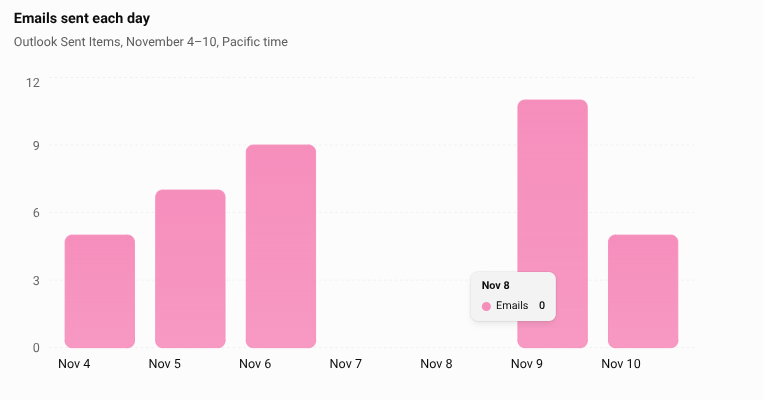
In the last seven days alone, my Outlook account shows 37 sent emails. Thirty-six went to outside addresses. Across those messages, there were 43 different recipient email addresses.Civil-rights complaints. Housing accommodations. Benefits corrections. Requests for medical records. Housing stabilization. Food assistance. Laundry money. Gift cards. Emergency transportation. Voucher briefings. Meetings with directors. Requests for investigations. Requests for someone to please just put a decision in writing.
And those emails are only one part of the work.
Based on my correspondence, document preparation, meetings, follow-ups and the walking routes I've described, a conservative reconstruction puts approximately 21 to 41 hours of my last week into trying to access services, document failures and obtain answers.That is an estimate, not a stopwatch record. And it may significantly understate how much time I actually lost.
Think about that.
An entire part-time to full-time workweek spent trying to get assistance from a system whose entire purpose is supposedly to provide assistance. What did all that work actually get me? Let's look at the return on investment. At my November 4 meeting with CHSP, I received two $50 gift cards. Both showed zero available balance when I tried using them. A hundred dollars in assistance that I couldn't spend. So I had to write again. Follow up again. Explain the problem again. Arrange another delivery. Confirm my address. Coordinate another person's schedule.
Four emails this week explicitly concerned those two unusable cards. Then there's Step Up.Someone took approximately a week's worth of my food. I didn't ask to have anybody arrested or evicted. I asked to have my groceries replaced.That resulted in four emails to Chris this week, including a correction explaining that I needed usable grocery money rather than another arrangement for food boxes.
The outcome?
Two Amazon gift cards are supposed to be available tomorrow, and I can go pick them up.
The laundry assistance I requested is still another issue entirely.
Four emails for stolen groceries. More emails for unusable gift cards. And I'm still trying to figure out how to wash my clothes.
Meanwhile, the rest of my life doesn't stop.
I went to Community Human Services. I met with CHSP. I went to the City of Salinas to discuss rent calculations, housing classifications and monitoring. I went back to DSS and worked through application problems, emergency assistance, and policies that apparently required me to identify the exact sections before staff would meaningfully address my questions.At DSS, I'd already made approximately six trips in a month trying to get my paperwork corrected I was fixing application errors, identifying unchecked disability and domestic-violence-related information, and asking for written decisions on emergency assistance while living on $340 a month in General Assistance. I got my benefit reinstatement notice. That was progress.
But why did getting to that point require so much of my time? Then there's the walking. I've described a normal route from Fairview to DSS on South Main, through the Plaza Grande area and back home. That trip was estimated at roughly five and a half to seven mile oday, I described walking between Central Coast Alliance, Community Human Services and Plaza Grande, another multi-stop trip estimated at five and a half to seven miles before returning home.
I've reported walking anywhere from five to thirteen miles on some days because I don't have reliable transportation money.I've come home so exhausted that I've fallen asleep for hours.And somehow, after all that, I'm still supposed to sit down at my computer, read regulations, organize evidence, make phone calls, respond to emails, and figure out which organization is responsible for the next thing.My phone and internet situation has become another administrative problem. I have two lines, limited equipment, and not enough money to make everything work the way I need it to.
And when I finally get a response, it's often another appointment, another referral, another form, another person who needs me to tell the entire story from the beginning.One of my earlier civil-rights meetings lasted approximately four hours. I explained the issues verbally, believing they would be investigated. The eventual findings didn't address the substantive allegations I believed I'd brought forward. Now I have to prepare a written agenda for the next investigation just to make sure the same thing doesn't happen again. I'm preparing the complaint, identifying the regulations, organizing the evidence, establishing the scope of the investigation, and requesting the documentation of the findings.
What exactly is left for the people who are paid to do this work? And today, after spending hours on all these issues, I watched a video of Kevin Goss talking about MCHOME.He described the ways they keep people housed. How they hold housing when someone relapses. How they provide motel rooms. How they prioritize safety and prevent people from returning to homelessness. And something clicked.
For a long time, I thought the failures I experienced were simply incompetence. Maybe the people responsible didn't know what services existed. Maybe they couldn't navigate their own programs. But here was someone publicly describing the very interventions I had repeatedly requested.I watched him explain how the system is capable of helping people.I know what happened when I asked for that help.I experienced an eviction process. I repeatedly asked for motel assistance and safety planning. I tried to obtain stabilization, transportation, food and a meaningful housing transition.
I ultimately had to do an extraordinary amount of that work myself.
Watching that video didn't establish why I was treated differently. But it made me reconsider the explanation I'd been giving people.Maybe this wasn't simply a question of capability. Maybe the question is why those capabilities weren't exercised in my case. I believe discrimination and prejudice may explain part of the difference. And I want that examined through the actual records, decisions, and testimony. Because this isn't only about what happened at Sun Rose anymore.
It's about what has happened to my time. Time I could have spent working. Going to school. Building IAM-THEBRAND. Making videos. Doing hair. Taking care of myself. Having a social life. Finding something exciting to do on a Tuesday afternoon.Instead, I am tracking gift cards, writing investigators, reviewing benefit applications, walking across Salinas, trying to get basic household necessities, and explaining for the hundredth time why I need everything in writing.
And at the end of the day, I still have to cook, eat, clean, do laundry, keep my phone functioning, and somehow make room for being a person. This is what my life looks like right now. Not one dramatic incident. Not one difficult appointment. Not one unreasonable person.
It's the accumulation of hundreds of small administrative battles that consume the hours, money, energy and attention I need to actually live.The system counts the services it provides. I wonder who counts the hours I spend trying to receive them.
Because my time has value, too.
And I want it back.