

From Permanent Supportive Housing to Displacement: A Connected Timeline
My housing history needs to be understood as a sequence of related decisions, not as a series of unrelated administrative problems.
I entered permanent supportive housing through a placement process I understood to involve Coordinated Entry and a CARS assessment. I remained in the same one-bedroom Sunrose apartment for approximately three years. My housing circumstances later deteriorated amid disputed rent and income calculations, an eviction process, and a rental assistance process that I believe failed to provide meaningful protection against displacement.
During that period, I retained my Sunrose keys because I did not want to voluntarily surrender my position while the housing dispute remained unresolved. I signed the Fairview lease on the 7th, while the Sunrose move-out date recorded in the timeline was the 24th. Those dates need to be evaluated alongside the effective dates of the leases, actual possession, court proceedings, and any formal transfer or referral.
The subsequent question is how Fairview's eligibility pathway was determined. I had previously been told that the placement involved CARS, and I understand that the program had a chronic-homelessness eligibility requirement. Yet I had been living in Sunrose permanent supportive housing, and my account is that I retained the keys during the period leading up to the recorded move-out date. The original Sunrose placement, my actual housing status during the dispute, and the eligibility determination for Fairview must therefore be distinguished.
The records also raise questions about service closure, transition planning, authorizations, and later HMIS changes. Those administrative records cannot, by themselves, establish whether I was actually receiving services or whether a housing transfer was properly authorized.
I am seeking a documented reconstruction of the entire sequence: what happened to the rental assistance, what decisions preceded the displacement, what my housing status was on the relevant dates, what eligibility criteria were applied to Fairview, and what records support the resulting decisions. These issues need to be reviewed together because the outcome of one process affected the circumstances in which the next process occurred.
2024–2026: Attempting to Exit an Unworkable Service Relationship
In 2024, I tried to get Interim to address my concerns, provide meaningful assistance, and process my request to exit the system. I was not simply asking to have my information removed from a database. I was trying to regain the ability to make decisions about my housing and care when I no longer believed the existing service relationship was working.
I had been told that someone would follow up with me around the Christmas and winter period. According to my experience, that follow-up did not result in the assistance I needed. I continued to experience a lack of meaningful support, and my efforts to have my situation addressed did not resolve the underlying problems.
By April 2025, I decided to close out with Interim. My decision followed the earlier attempts to obtain help and an exit. I did not want to remain under a service arrangement in which I felt I was being counted as a participant without receiving the services that participation was supposed to provide. I also did not want to continue depending on Interim or remain tied to Monterey County's system when I was trying to establish a different path forward.
From April 2025 until approximately February 2026, I experienced a gap in mental-health services, medical support, medication support, and doctor's visits, as I recall it. I did not re-engage with Interim because I had lost confidence in that relationship. Instead, I took responsibility for establishing my own care in Santa Cruz, with a new provider and doctor. I was trying to build an independent care arrangement, not abandon my healthcare needs.
This distinction matters. My decision not to sign back on for Interim services should not be treated as though I had rejected all care or no longer needed support. I was trying to obtain care through a different provider and in a different county because I did not want to return to the arrangement I had tried to leave.
Then, during the housing and eviction crisis, I was placed at Fairview. I understood that I had closed out with Interim and was attempting to separate myself from the Monterey County service structure. Yet Fairview raised new questions about the relationship between my housing placement, behavioral-health programs, funding arrangements, and service-provider connections.
I therefore need the agencies to explain, in writing, what program I was placed in at Fairview; which entity funded, referred, or authorized the placement; what contractual relationship exists between Fairview housing and behavioral-health services; whether participation in any particular service program is required; and how the Fairview placement was reconciled with my earlier closeout from Interim.
The issue is not that I object to housing or healthcare. I was trying to obtain both on terms that allowed me to move forward. The unresolved question is whether I was actually able to leave the original service arrangement—or whether I moved into another housing arrangement connected to the same broader system without being given a clear explanation of the connection, the requirements, or my options.
Effective Communication and Meaningful Participation
The U.S. Department of Justice's ADA Requirements: Effective Communication guidance explains that covered state and local government entities and public accommodations must provide effective communication to people with covered communication disabilities. The guidance directs covered entities to consider the nature, length, complexity, and context of the communication and the individual's usual method of communication. It also states that Title II public entities must give primary consideration to the communication aid or service requested by the individual, subject to the applicable limitations, and that an undue-burden determination by a state or local government must be made by a high-level official and supported by a written statement of reasons.
For purposes of this record, these principles identify questions to examine when evaluating accommodation requests, grievance meetings, healthcare communications, and opportunities to participate in administrative processes. The relevant inquiry is what accommodation was requested, what the organization knew, how it responded, and whether the arrangement provided effective access under the requirements applicable to that particular entity and interaction.
Source: U.S. Department of Justice, Civil Rights Division, ADA Requirements: Effective Communication, last updated February 28, 2020. This is technical-assistance guidance, not a substitute for the governing statute or regulation.
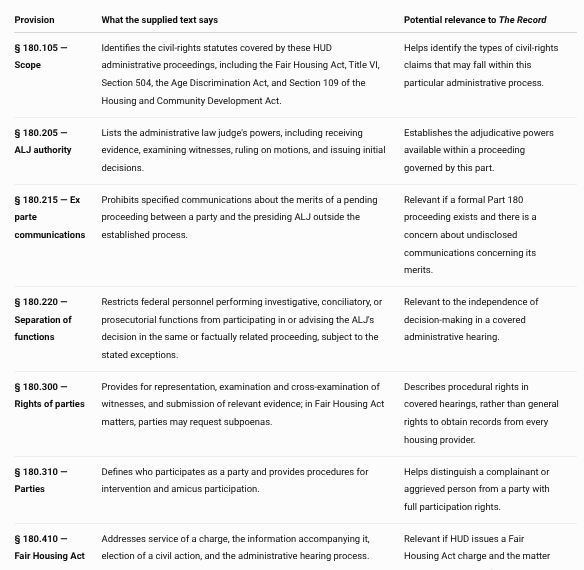
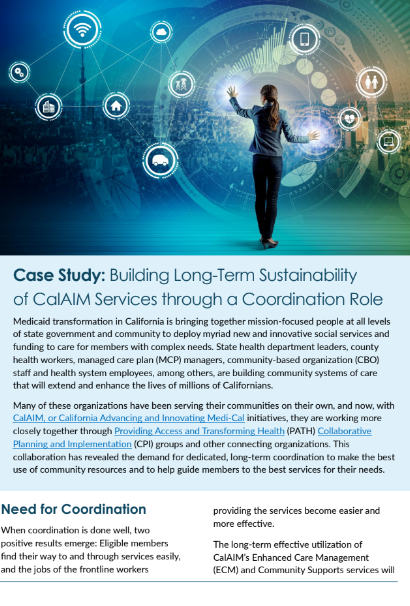
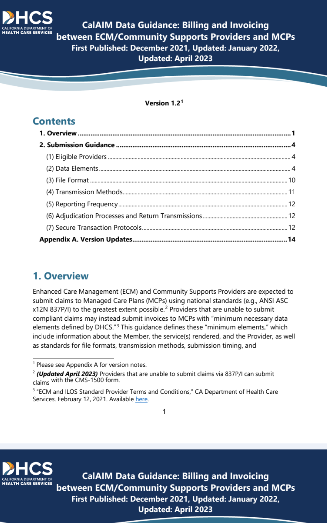

CAL AIM CASE STUDY
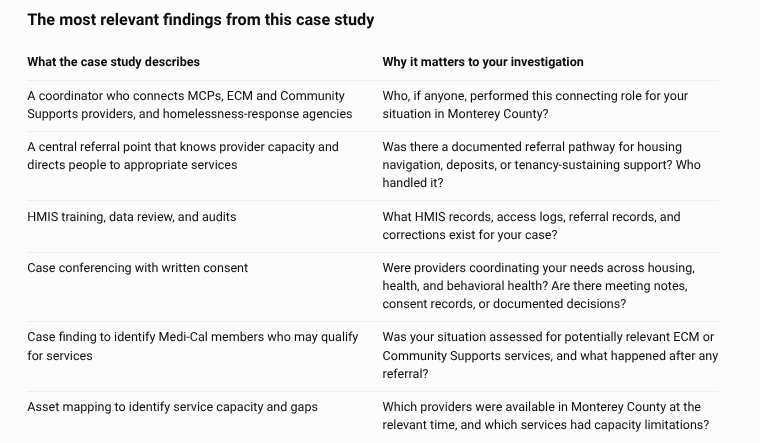
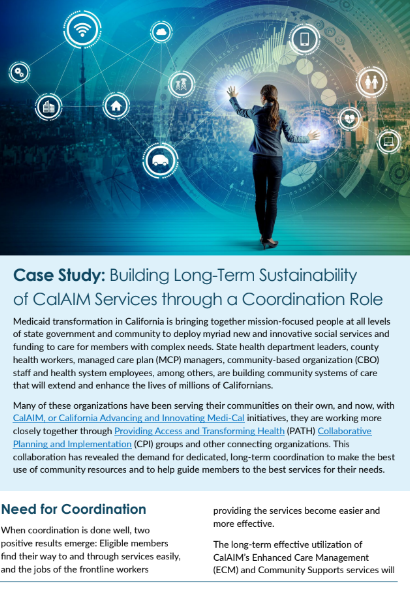
The most consequential passages are the ones about HMIS and closed-loop referrals.
The case study says the coordinator regularly reviews and audits HMIS information to support provider handoffs and help ensure referrals result in services and care. It also describes case conferencing in which, with written consent, providers discuss the person's needs, identify additional services, and determine who will provide them.
That creates a concrete investigative question:
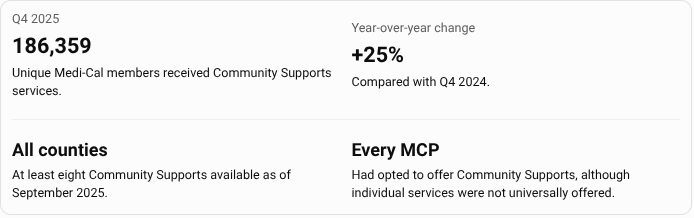
CITED
Purpose: PATH CITED funding supports the transition, expansion, and development of ECM and Community Supports capacity and infrastructure.
Eligible applicants: Organizations actively contracted to provide ECM or Community Supports, or able to provide the required signed attestation of an intended contract.
Examples of allowable uses: Workforce expansion; infrastructure for CalAIM and ECM/Community Supports; monitoring services; and outreach to underserved populations.
Coordination: Applicants are encouraged to coordinate applications with local organizations they contract with or intend to contract with.
Funding rounds: Round 4 closed May 2, 2025. The page also announces that 139 organizations across California counties completed Round 1 projects, according to DHCS’s January 27, 2026 announcement.
Accountability records: The page identifies progress-report guidance and payroll-log templates, which may help identify what awardees were required to document. The exact obligations depend on the applicable award documents and guidance.
A concrete Monterey County lead
I checked DHCS’s published CITED Round 3 awardee list, rather than relying only on the general funding overview. It identifies organizations serving Monterey County and describes their funded service capacity.
tpa-reference-material-prod.s3.us-west-2.amazonaws.com
Franciscan Workers of Junipero Serra, dba Dorothy’s Place
CITED Round 3 approved amount
$774,121.20
Monterey County
The awardee summary describes Dorothy’s Place as a nonprofit contracted to provide ECM to several adult populations of focus, including people experiencing homelessness and people with serious mental illness and/or substance-use needs. It also lists Housing Transition Navigation Services, Housing Deposits, and Housing Tenancy and Sustaining Services among the Community Supports it was contracted to provide in Monterey County. The stated funding purpose included staffing, IT equipment, billing services, and training to expand ECM delivery and support long-term sustainability.