Public funding. Housing stability. Program outcomes. A record that deserves scrutiny.
An ongoing documentary review of Sun Rose Housing, its publicly funded services, reported outcomes, and the financial records available for independent review.
Why follow the funding?
Sun Rose sits at the intersection of affordable housing, supportive services, behavioral health, and public accountability. Understanding how the program operates requires looking beyond a single budget, an annual report, or a nonprofit's overall financial statements.
The questions are straightforward:
What funding supports the housing itself?
What funding pays for supportive services?
What services and staffing arrangements are required by the applicable agreements?
How does the program report its outcomes?
What do the available records establish about spending, service delivery, and housing stability?
Where do the records leave unanswered questions?
These are questions about documentation and accountability. They should be answered with contracts, financial records, program reports, and actual performance data—not assumptions about how a program ought to work.
1. Housing and supportive services are not the same funding question
Sun Rose's housing structure and its supportive-services program must be examined separately, even when they serve the same residents.
The available records include a City of Salinas rental regulatory agreement and declaration of restrictive covenants associated with Sun Rose Housing, as well as separate behavioral-health service agreements and program reporting.
Those documents serve different purposes.
A recorded affordability agreement can establish restrictions on rents, occupancy, or property use. A behavioral-health services agreement can establish a different set of service, budget, reporting, and performance requirements. Neither document should automatically be treated as proof of every obligation contained in the other.
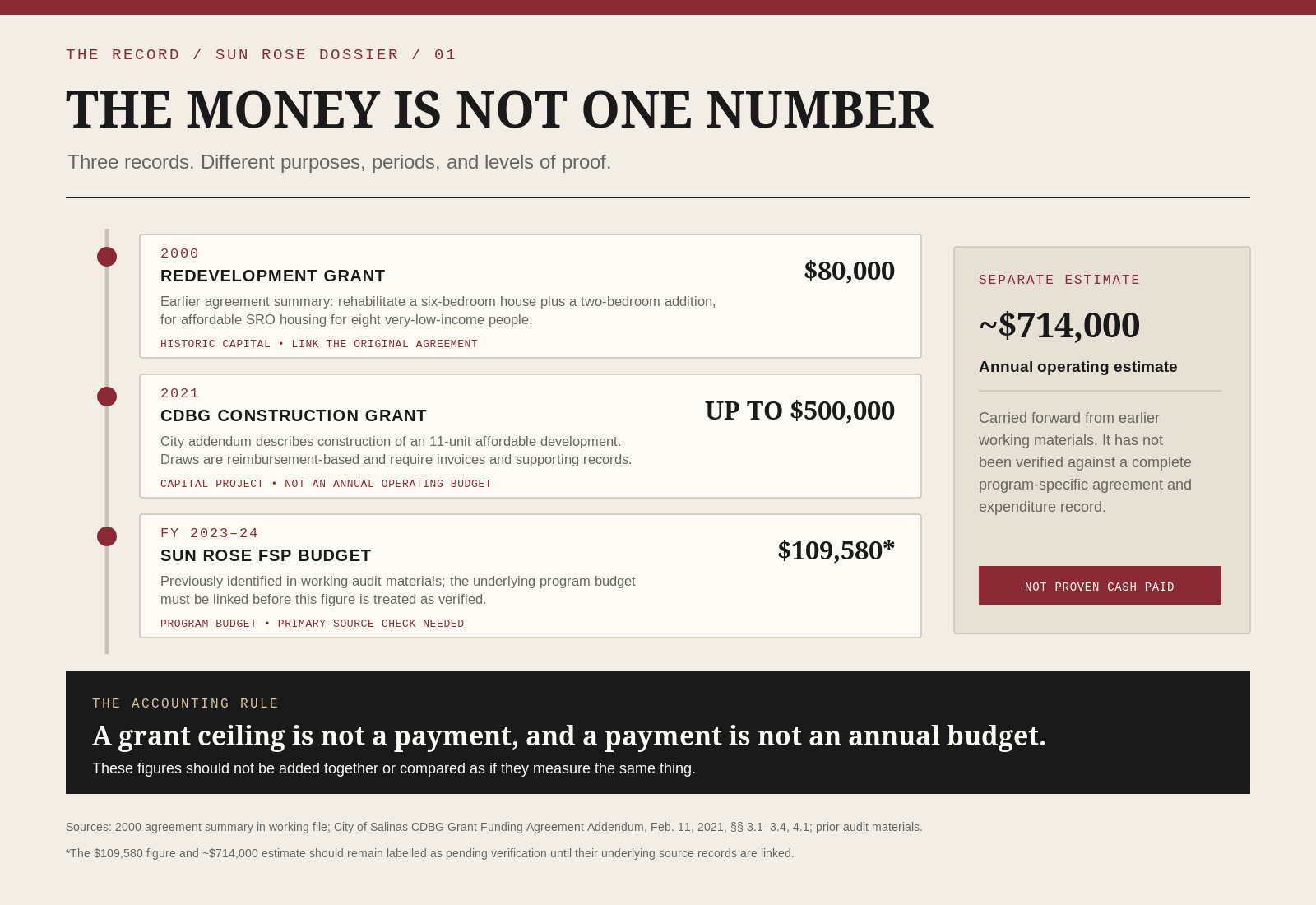
Likewise, a capital grant used to develop or rehabilitate housing is not the same thing as an annual operating budget. A contractual budget is not necessarily the amount actually paid, and a payment to a provider is not automatically proof that a particular service was delivered.
The financial record must be traced from the source of the funding to its authorized purpose, the applicable agreement, reported expenditures, and documented results.
2. What the available financial records show
The records assembled for this review include nonprofit financial disclosures, County behavioral-health materials, housing agreements, and service-contract documents.
These sources need to be read at the correct level.
Organization-wide finances
Interim, Inc.'s nonprofit financial disclosures describe the organization as a whole. They include revenue, expenses, compensation, and other financial information across its operations.
Those disclosures provide useful context about the organization. They do not, by themselves, establish how much money was allocated to Sun Rose, how much Sun Rose actually received, or how much was spent on any individual resident or service.
For that, program-specific budgets, expenditure reports, payment records, and applicable contract exhibits are needed.
Program-level budgets
The working audit materials identify a figure of $109,580 for the Sun Rose FSP budget in fiscal year 2023–24. The same materials identify a separate approximate annual operating figure of about $714,000, which still requires reconciliation to the underlying agreements and source records.
These figures should not be treated as interchangeable. Before drawing conclusions, the applicable program, fiscal period, funding stream, budget category, and source document must be confirmed.
A budgeted amount, an authorized contract amount, an actual expenditure, and a cash payment are four different things.
This review will identify those distinctions rather than combine the figures into a single headline.
3. What the County reported about Sun Rose
Monterey County's FY 2024–25 Community Services and Supports Annual Report includes reporting on the Sun Rose Full Service Partnership (FSP).
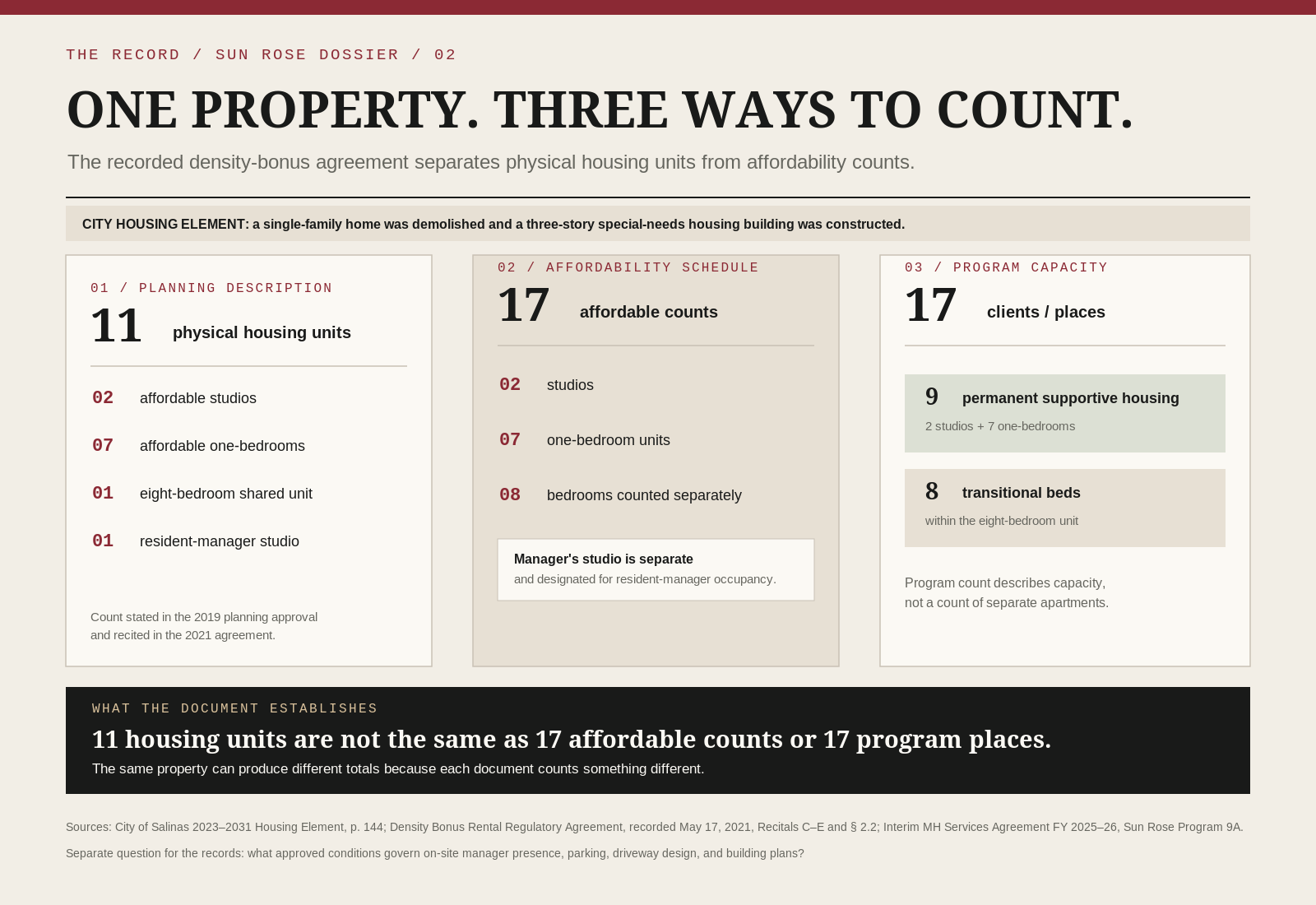
The report describes a program with 17 housing places: eight transitional and nine permanent. It reports that 25 clients were served during the year and that 92% were housed at year-end or exited to another permanent housing destination.
The report also includes measures relating to satisfaction, primary-care contact, psychiatric hospitalization, incarceration, and client discharges.
These are relevant program indicators. They are not, on their own, a complete account of how residents moved through the housing system.
For example, a combined measure of people housed at year-end and people who exited to another permanent destination does not necessarily reveal:
How many transitional residents moved into permanent housing.
How many residents exited to destinations that remained stable over time.
How many residents returned to homelessness or required another intervention.
Whether permanent and transitional residents experienced comparable access to services.
How the reported figures were calculated and what denominator was used.
The report also acknowledges staffing shortages affecting group programming, difficulties maintaining occupancy through referrals, and challenges associated with substance and alcohol use affecting tenancy stability.
Those statements deserve to be considered alongside the program's reported successes. Neither should be omitted when assessing the overall record.
4. Housing occupancy and long-term stability
A program can report the number of people served during a year without fully explaining the pathways those people followed.
For a program that combines transitional housing with permanent supportive housing, it is important to distinguish between maintaining a permanent placement and successfully transitioning someone out of temporary housing into a stable long-term destination.
The number of clients served, the number of occupied units, the length of engagement, and the number of successful transitions measure different things.
This review will therefore examine whether published outcomes distinguish between:
Residents in permanent supportive housing.
Residents in transitional housing.
Residents who moved into another permanent destination.
Residents discharged after achieving some or all program goals.
Residents whose housing or service outcomes remain unclear in the available records.
The purpose is not to assume that reported outcomes are inaccurate. It is to establish what those outcomes measure, how they were calculated, and what they leave out.
5. Staffing, service delivery, and contractual obligations
A program's published outcomes should also be considered alongside the resources and services available to residents.
Staffing shortages can affect access to counseling, housing navigation, crisis response, group programming, and continuity of care. The County's report acknowledges staffing challenges, but the available summary does not establish the full staffing history, the duration of individual vacancies, or the effect on each resident.
Those questions require comparison with staffing records, service logs, the operative service agreement, and any specific requirements governing the housing and support model.
A vacancy does not automatically establish a contractual breach. Equally, a published outcome does not establish that every required service was consistently available.
The relevant question is whether the services and staffing actually provided matched the requirements and representations applicable to the program during the period under review.
6. What still needs to be established
This investigation will continue to compare the available records with the underlying source documents.
Priority questions include:
What were the approved Sun Rose program budgets for each relevant fiscal year?
Which funding streams supported the property's development, ongoing operations, and supportive services?
What amounts were authorized, invoiced, paid, and ultimately reported as expenditures?
Which service and staffing obligations appear in the operative agreements and incorporated exhibits?
How were the County's reported housing and discharge outcomes defined and calculated?
How did staffing availability, service delivery, occupancy, and resident transitions change over time?
Which records would allow the public to independently reconcile reported outcomes with actual program operations?
Where the records do not yet answer a question, it will remain identified as unresolved rather than presented as a proven violation.
Why this matters
Publicly funded housing and supportive services should be evaluated using evidence that allows people outside the provider organization to understand what was funded, what was required, what was delivered, and what outcomes were achieved.
People who rely on these programs experience the difference between a service described in a report and a service available when it is needed. Financial accountability and program accountability are therefore connected, even though they require different evidence.
The goal of this review is to make those records understandable, identify inconsistencies that warrant further examination, and distinguish documented facts from questions that remain unanswered.
Follow the funding. Read the agreements. Examine the outcomes. Preserve the record.
Sources and documentation
This section is an ongoing review. Relevant source materials include:
Monterey County's FY 2024–25 Community Services and Supports Annual Report, including the Sun Rose FSP reporting.
City of Salinas and Sun Rose Housing rental regulatory and affordability documents.
Interim, Inc. behavioral-health service agreements and applicable budget exhibits.
Interim, Inc. nonprofit financial disclosures.
Program-specific budgets, expenditure records, staffing documentation, and outcome definitions as they become available.
Financial amounts and program findings should be read in the context of the specific fiscal year and source document. Additional records and corrections will be incorporated as the review develops.
Last updated: October 2026.